When products are being prepared for storage or transportation, the packaging needs to do more than simply cover the pallet. It needs to hold the load together, withstand handling and provide consistent performance throughout the supply chain.
This is where nano stretch film has become an interesting development in modern pallet packaging.
Advances in cast extrusion technology have allowed manufacturers to develop stretch films with increasingly sophisticated multi-layer structures. These films can be engineered to combine properties such as strength, stretchability and load retention while supporting more efficient material use.
For businesses wrapping large volumes of pallets, understanding how nano stretch film works and what it can offer is an important part of making better packaging decisions.
What Is Nano Stretch Film?
Nano stretch film refers to highly engineered stretch film manufactured using advanced multi-layer extrusion technology.
Rather than relying on a simple film structure, the film is produced using multiple layers that can contribute different performance characteristics.
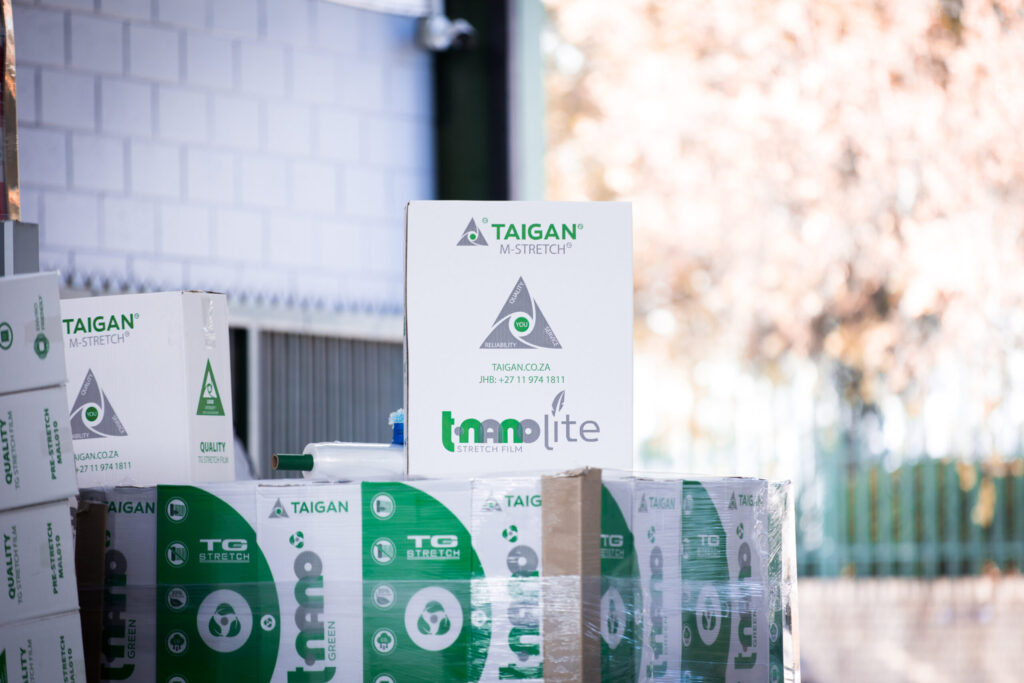
Taigan M-Stretch’s t.nano range is based on multi-layer cast stretch film technology and includes 33-layer, 55-layer and 67-layer cast stretch film.
The technology behind these products is designed to deliver a combination of strength, stretchability and load stability for pallet wrapping applications.
The name “nano” reflects the advanced film technology behind the t.nano product range rather than suggesting that the film is a completely different type of plastic packaging.
Why Does Film Structure Matter?
At first glance, stretch film can appear to be a straightforward packaging material.
In reality, its performance can be influenced by the way it is manufactured.
Multi-layer extrusion allows different characteristics to be incorporated into the film structure.
This can contribute to properties such as:
- Strength
- Stretchability
- Puncture resistance
- Load retention
- Film consistency
- Containment
The precise balance between these properties is important because pallet loads can vary considerably from one application to another.
Nano Stretch Film and Pallet Stability
One of the primary purposes of stretch film is to help create a stable pallet.
Products stacked on a pallet can move independently when exposed to vibration, handling and transportation.
Stretch film creates tension around the load and helps hold the individual products together.
A well-contained pallet can be easier to handle and can provide greater confidence during transportation.
However, the film itself is only one part of the equation.
Load configuration, wrapping technique, equipment and operator training all contribute to the final result.
Why Thinner Film Can Still Be Strong
One of the developments in modern stretch film technology is the ability to produce thinner films without simply sacrificing performance.
This is important because film thickness alone does not tell the complete story.
A thicker film is not automatically a stronger or more efficient solution.
Film construction and performance characteristics need to be considered alongside thickness.
The t.nano range is designed around this principle by combining multi-layer cast extrusion technology with stretch and strength characteristics suited to pallet wrapping applications.
The Importance of Stretch
Stretch is a fundamental characteristic of pallet wrapping film.
As the film is applied to a pallet, it stretches around the load and creates tension.
This tension contributes to load containment.
However, the film needs to stretch in a controlled way.
If it stretches too easily without sufficient holding force, the load may not receive the required containment.
If it does not stretch effectively, excessive film may be required.
The balance between stretch and holding force is therefore an important consideration when selecting a stretch film.
Nano Stretch Film for Different Applications
Not every pallet requires the same packaging solution.
Some loads may be lightweight and uniform.
Others may be heavy, irregular or difficult to contain.
Businesses should consider:
- Product weight
- Pallet dimensions
- Load shape
- Product configuration
- Transport conditions
- Wrapping equipment
- Required containment
These factors can help determine which stretch film is appropriate.
The t.nano range provides different film constructions to support a variety of hand and machine wrapping applications.
The t.nano Product Range
Taigan M-Stretch’s t.nano range includes:
t.nano 33 Layer
The 33-layer cast stretch film forms part of the t.nano range and is designed for pallet wrapping applications where strength and stretch performance are important.
t.nano 55 Layer
The 55-layer option provides another multi-layer construction for applications requiring specific performance characteristics.
t.nano 67 Layer
The 67-layer film represents another level within the t.nano range and is designed for demanding pallet wrapping requirements.
The appropriate product depends on the individual application rather than simply choosing the highest number of layers.
What Does Multi-Layer Mean?
Multi-layer stretch film is produced by combining multiple layers of material within the film structure.
Each layer can contribute to the overall performance of the finished film.
This allows manufacturers to engineer films that provide a combination of properties rather than relying on one characteristic.
For pallet wrapping, this can be particularly useful because the film needs to perform several functions at once.
It needs to stretch.
It needs to contain the load.
It needs to resist damage.
It needs to maintain performance during transportation.
Nano Stretch Film for Machine Wrapping
High-volume operations often use semi-automatic or automated pallet wrapping equipment.
Machine wrapping can provide a consistent wrapping pattern and controlled film application.
This can be particularly useful where businesses need to wrap large numbers of pallets.
Taigan M-Stretch’s t.nano machine rolls are designed for semi-automatic and automated machine lines.
Using the correct film with the appropriate equipment can help businesses achieve more consistent wrapping results.
Nano Stretch Film for Hand Wrapping
Not every operation uses automated wrapping equipment.
Manual pallet wrapping remains an important part of many warehouses and manufacturing facilities.
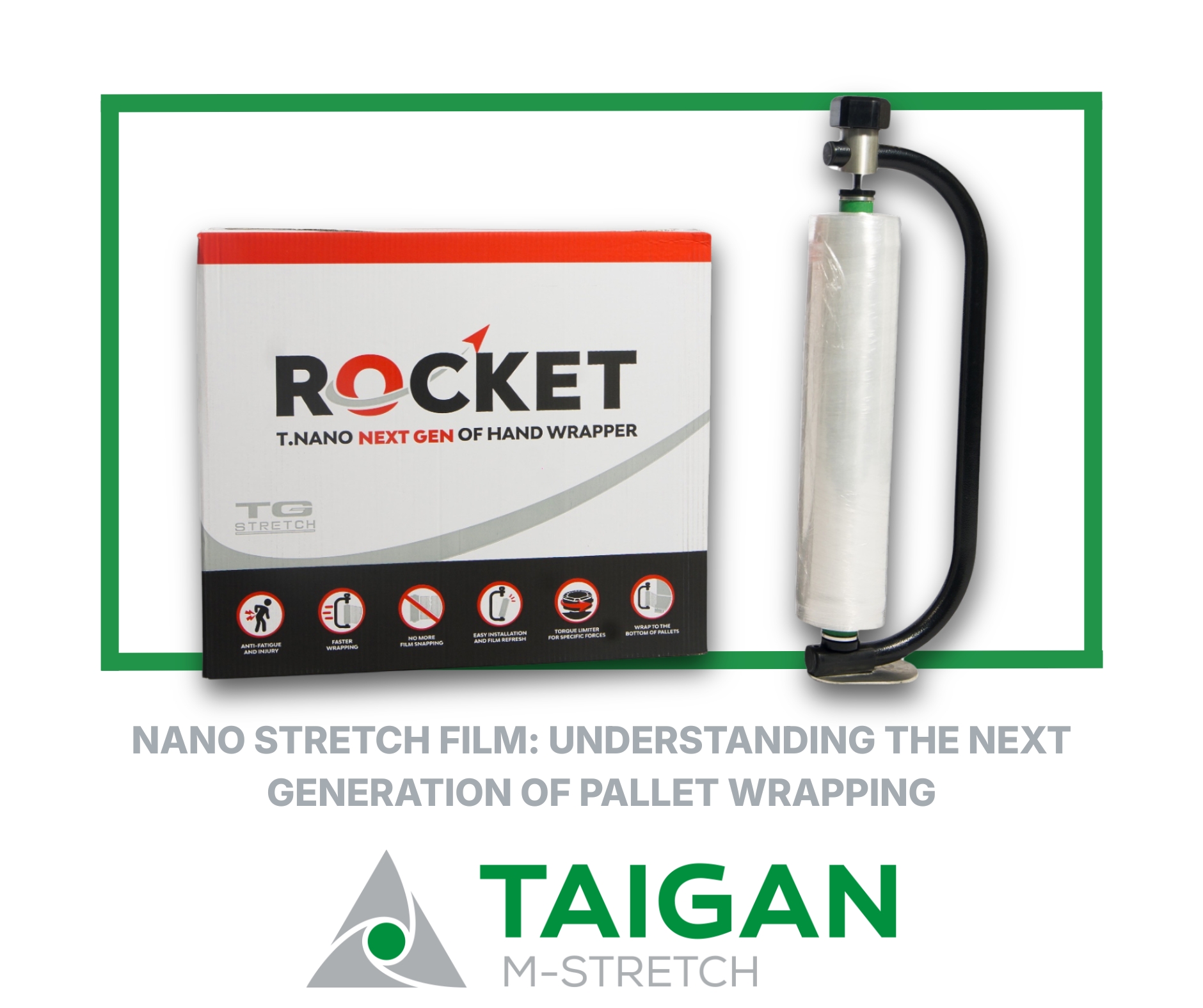
t.nano hand wrappers are designed for manual applications.
They are pre-stretched to 300% and use folded-edge technology according to Taigan’s product information.
This provides businesses with a hand wrapping option designed around efficient film application.
Why Operator Technique Matters
Even advanced stretch film needs to be applied correctly.
Manual wrapping can produce different results depending on the operator.
One person may apply excessive film while another may not create sufficient containment.
This can result in inconsistent packaging performance.
Training helps operators understand how the film should be applied and how to identify problems with the finished pallet.
Packaging Efficiency and Film Consumption
For businesses wrapping hundreds or thousands of pallets, film consumption can become an important operating cost.
The objective should not simply be to use the least amount of film possible.
Instead, businesses should aim to use the appropriate amount of film to achieve the required load stability.
This is where packaging optimisation becomes valuable.
What Is Packaging Optimisation?
Packaging optimisation involves reviewing the complete wrapping process to determine whether it is delivering the required result efficiently.
This can involve assessing:
- Film selection
- Film consumption
- Wrapping technique
- Pallet configuration
- Machine settings
- Operator training
- Load stability
The goal is to find the right balance between performance and material use.
Yield Testing and Nano Stretch Film
Yield testing can provide useful information about how efficiently stretch film is being used.
Rather than estimating film consumption, businesses can measure how much material is actually applied to each pallet.
This information can then be compared with load stability and wrapping performance.
Yield testing may reveal that a business is using more film than necessary or that different operators are producing significantly different results.
These findings can help identify practical opportunities for improvement.
Why More Film Is Not Always Better
It is tempting to assume that adding more film will automatically create a stronger pallet.
However, excessive film usage can increase packaging costs without necessarily providing a proportional improvement in containment.
The opposite is also true.
Reducing film too aggressively may compromise load stability.
The correct approach is to determine what the particular load requires.
Packaging Assessments
A packaging assessment can help businesses understand their current wrapping process.
The assessment may examine:
- The products being wrapped
- The pallet configuration
- The current film
- The wrapping equipment
- Film consumption
- Wrapping technique
- Load stability
This creates a more complete picture of packaging performance.
Instead of simply asking whether a film is “good”, businesses can ask whether it is performing effectively within their specific application.
Reducing Unnecessary Material Usage
Efficient packaging does not necessarily mean using less film at all costs.
It means avoiding unnecessary consumption while maintaining the required level of protection.
Better film technology can contribute to this when combined with an appropriate wrapping process.
Training and regular packaging assessments can also help prevent inefficient application.
Nano Stretch Film and Sustainability
Businesses are increasingly examining the amount of packaging material they use.
Reducing unnecessary material consumption can help reduce packaging waste.
Taigan M-Stretch has also introduced initiatives focused on material reuse.
Its core swop programme allows customers to collect used green cores in flow bins so that Taigan can retrieve and reuse them.
This helps customers keep production areas more organised while extending the use of the cores.
Post-Recyclable Content in t.nano
According to Taigan’s product information, the t.nano range includes film containing 30% post-recyclable content.
Taigan also states that its stretch film is recyclable.
These characteristics form part of the company’s wider approach to packaging material efficiency.
It is important to distinguish specific material and recycling initiatives from broad environmental claims. The value lies in the actual measures being implemented within the packaging process.
How Nano Stretch Film Can Support Businesses
For businesses with significant pallet wrapping requirements, the potential benefits of advanced stretch film technology can include:
- Improved load containment
- Consistent wrapping performance
- Efficient film application
- Better material utilisation
- Stronger pallet stability
- Support for machine wrapping
- Options for manual wrapping
The actual results will depend on the application and how the film is used.
Common Mistakes When Selecting Stretch Film

Businesses can sometimes make packaging decisions based on limited information.
Choosing Only on Price
The cheapest roll may not provide the best overall value.
Focusing Only on Thickness
Thickness alone does not determine performance.
Ignoring the Load
A film should be selected based on the products and pallet configuration.
Ignoring Equipment
Machine wrapping requires film that performs appropriately with the equipment.
Failing to Test
Without testing, businesses may not know whether their current process is efficient.
Using the Same Film for Everything
Different applications may require different film characteristics.
How to Choose the Right Nano Stretch Film
A practical selection process can begin with a few questions.
What Are You Wrapping?
Understand the weight, shape and configuration of the load.
How Are You Wrapping It?
Determine whether the application is manual, semi-automatic or automated.
What Is Your Current Film Usage?
Measure rather than estimate consumption.
What Problems Are You Experiencing?
Look for instability, film breakage, excessive usage or inconsistent results.
What Does the Finished Pallet Need to Achieve?
Determine the required level of load containment.
These answers provide a much better starting point for film selection.
The Importance of Technical Support
Stretch film technology can be difficult to evaluate simply by looking at a roll.
Businesses may benefit from working with packaging specialists who understand the relationship between film performance and application.
Technical support can include:
- Film selection
- Packaging assessments
- Yield testing
- Operator training
- Wrapping optimisation
- Application advice
This helps businesses make decisions based on their actual packaging requirements.
Taigan M-Stretch and t.nano
Taigan M-Stretch established its business around three principles known as the Triangle of Trust: Quality, Service and Reliability.
The company has focused on stretch film and packaging solutions since 2005.
Its t.nano range represents its approach to multi-layer cast stretch film technology with 33-layer, 55-layer and 67-layer products for different applications.
Taigan also provides technical support and training to help customers improve their packaging processes.
Supporting Customers Across South Africa

Taigan M-Stretch has distribution centres in:
- Johannesburg
- Cape Town
- Mbombela
- Gqeberha
This national footprint allows Taigan to support businesses across South Africa while developing long-term customer relationships.
For businesses with multiple locations, access to consistent product supply and packaging support can be particularly valuable.
Nano Stretch Film Is Only One Part of the Solution
Advanced film technology can provide significant benefits but it should never be considered separately from the rest of the packaging process.
A successful pallet wrapping system combines:
The right film + the right load + the right equipment + the right application
If any one of these elements is overlooked, performance may suffer.
This is why packaging optimisation should always consider the complete application.
Frequently Asked Questions
What is nano stretch film?
Nano stretch film is an advanced multi-layer stretch film designed to provide a combination of strength, stretchability and load containment for pallet wrapping applications.
What is t.nano?
t.nano is Taigan M-Stretch’s range of multi-layer cast stretch film. The range includes 33-layer, 55-layer and 67-layer products.
Is nano stretch film suitable for machines?
Yes. Taigan’s t.nano machine rolls are designed for semi-automatic and automated wrapping applications.
Can nano stretch film be used by hand?
Yes. The t.nano range also includes hand wrapping products designed for manual applications.
Does thinner stretch film mean weaker packaging?
Not necessarily. Film performance depends on its construction and characteristics rather than thickness alone.
How can I determine whether I am using too much stretch film?
Yield testing can measure actual film consumption per pallet and compare it with the required load containment.
Conclusion
Nano stretch film represents the continued development of stretch film technology for modern pallet wrapping applications.
Through advanced multi-layer cast extrusion, films can be engineered to combine properties such as strength, stretchability and load retention. Taigan M-Stretch’s t.nano range applies this approach through its 33-layer, 55-layer and 67-layer cast stretch film products.
However, the film itself is only part of the equation.
The best packaging results come from matching the film to the load, using the appropriate wrapping method and ensuring operators or equipment apply the film consistently. Yield testing and packaging assessments can then help businesses measure performance and identify opportunities for improvement.
For businesses looking to improve pallet wrapping, understanding the technology behind the film is a useful starting point. The right solution is not necessarily the thickest film or the cheapest roll. It is the film and wrapping process that provide the required containment while making efficient use of packaging materials.
That is where advanced stretch film technology and a properly assessed packaging process can work together to create better results.