
A pallet may look simple once it has been wrapped and is ready to leave a warehouse. Behind that finished pallet, however, is a packaging process that needs to balance product protection, load stability, material usage and efficiency.
For businesses wrapping large volumes of products, choosing the right film can make a meaningful difference.
Multi-layer stretch film has become an important part of modern pallet wrapping because its construction allows manufacturers to engineer different performance characteristics into one film.
Instead of viewing Multi-Layer Stretch Film simply as plastic wrapped around a pallet, it is useful to understand how the film’s construction can influence its performance.
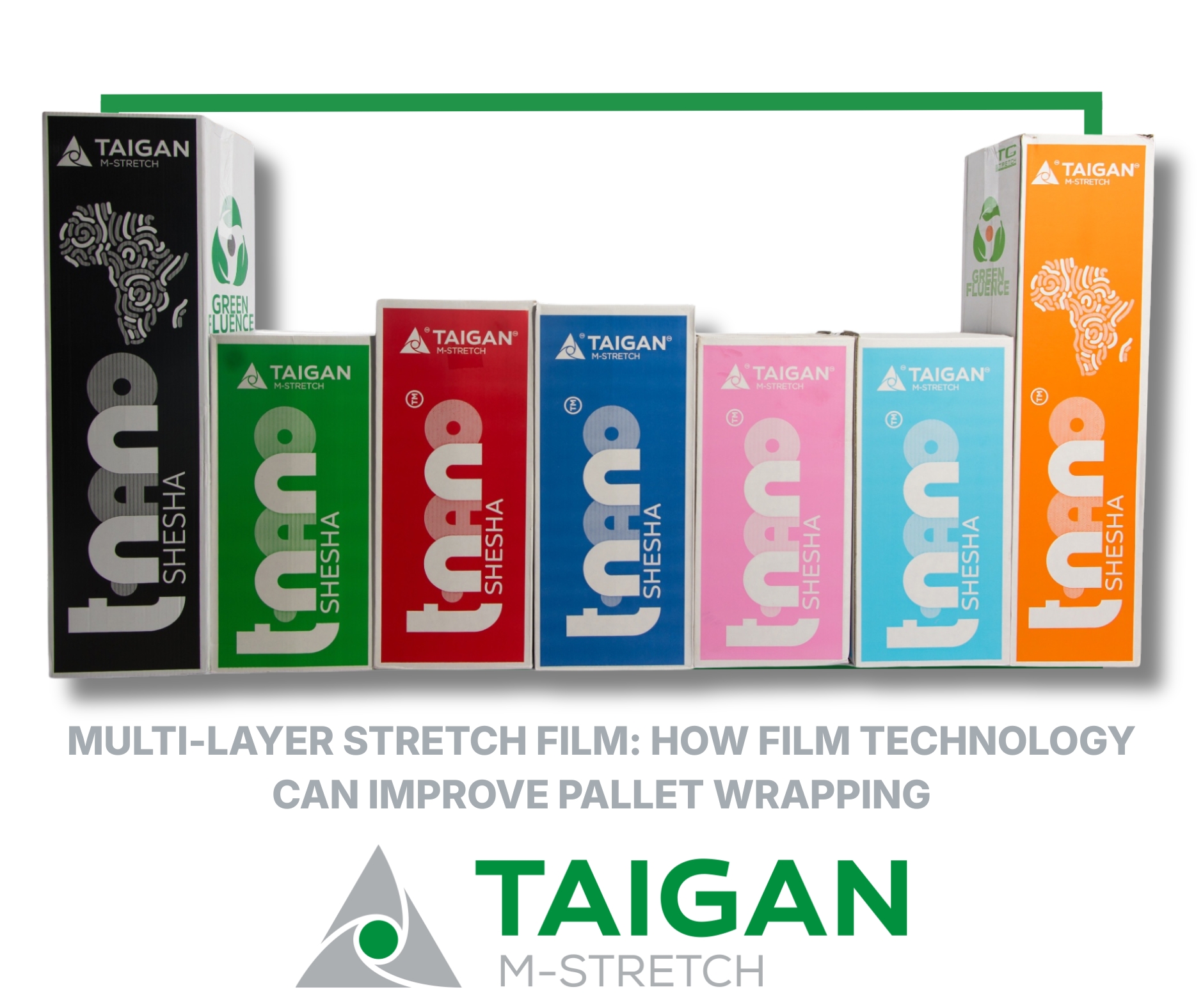
Taigan M-Stretch’s t.nano range uses multi-layer cast extrusion technology to produce stretch film designed for a range of hand and machine wrapping applications.
What Is Multi-Layer Stretch Film?
Multi-layer stretch film is produced by combining multiple layers within the structure of the finished film.
Each layer can contribute to the overall performance of the product.
This approach allows manufacturers to develop films with a combination of characteristics such as:
- Strength
- Stretchability
- Puncture resistance
- Load retention
- Containment
- Consistency
The objective is not simply to create more layers.
The important consideration is how those layers work together to create a film that performs effectively during pallet wrapping.
Why Does the Construction of Stretch Film Matter?
Multi-Layer Stretch Film needs to perform several jobs simultaneously.
It must stretch around a load while maintaining sufficient tension. It needs to resist damage during application and it needs to help hold the palletised products together during handling and transportation.
These requirements can be challenging to balance.
Multi-Layer Stretch Film technology provides manufacturers with greater flexibility when developing film structures for specific applications.
This is one reason modern stretch films can deliver strong performance while using less material than some traditional approaches.
Multi-Layer Stretch Film and Pallet Stability
Load stability is one of the most important objectives of pallet wrapping.
Products can shift when pallets are moved by forklifts or transported over long distances.
A properly applied stretch film helps create containment around the load.
The film essentially brings the products together and helps reduce movement between individual items.
However, load stability is influenced by more than film.
It can also depend on:
- Product arrangement
- Pallet condition
- Load weight
- Product dimensions
- Film selection
- Wrapping pattern
- Machine settings
- Application technique
The film therefore needs to be considered as part of the complete packaging system.
The Role of Stretchability
Stretchability is fundamental to how stretch film works.
As the film is applied, it stretches around the load.
This creates tension which contributes to containment.
But not all stretching behaviour is the same.
A suitable film needs to provide controlled stretch while maintaining the holding force required for the application.
If too much film is applied without considering the load requirements, packaging costs can increase.
If too little containment is created, the pallet may become unstable.
The objective is to achieve the appropriate balance.
Strength and Puncture Resistance
Pallets do not always contain perfectly uniform products.
Some loads have sharp corners or irregular shapes which can place additional stress on the film.
A film with suitable strength and puncture resistance can help withstand these demands.
Multi-Layer Stretch Film construction can be engineered to provide a combination of properties that support demanding applications.
This can be particularly useful in industrial environments where pallets need to withstand repeated handling.
Taigan’s t.nano Multi-Layer Range
Taigan M-Stretch’s t.nano range is based on multi-layer cast stretch film technology.
The range includes:
- 33-layer cast stretch film
- 55-layer cast stretch film
- 67-layer cast stretch film
These products are designed for different pallet wrapping applications.
The number of layers should not be viewed as a simple ranking where the highest number is automatically the best option.
The appropriate film depends on the application and the performance required.
Understanding the 33-Layer, 55-Layer and 67-Layer Range
Each t.nano product is designed around a particular film construction.
Businesses should therefore consider the application rather than selecting a film simply because it has more layers.
Factors that can influence the choice include:
- Load weight
- Product type
- Pallet configuration
- Wrapping equipment
- Transport requirements
- Required containment
- Film consumption
A packaging assessment can help determine which product is most appropriate.
Multi-Layer Cast Stretch Film
The t.nano range is manufactured using cast extrusion technology.
Multi-Layer Stretch Film is produced by extruding the film through a flat die before it is cooled and formed.
This manufacturing process allows the film to be produced with controlled characteristics and consistent thickness.
For industrial pallet wrapping, consistency is important because businesses need the film to perform reliably from one pallet to the next.
Machine Wrapping Applications
Large warehouses and manufacturing operations often need to wrap significant numbers of pallets.
Manual wrapping may become increasingly time-consuming as pallet volumes increase.
Semi-automatic and automated wrapping equipment can help create a more consistent wrapping process.
Taigan’s t.nano machine rolls are designed for use on semi-automatic and automated machine lines.
The film and equipment should be considered together because machine settings can influence how the film performs.
Why Machine Settings Matter
Even a high-performance stretch film can deliver poor results if the machine is not configured correctly.
Settings can influence:
- Film tension
- Wrapping speed
- Number of rotations
- Film application
- Overlap
- Top and bottom wrapping
These variables should be adjusted according to the load and the film being used.
The aim is to create a repeatable wrapping process.
Hand Wrapping Applications
Machine wrapping is not suitable for every operation.
Businesses with lower pallet volumes or highly variable loads may still rely on manual wrapping.
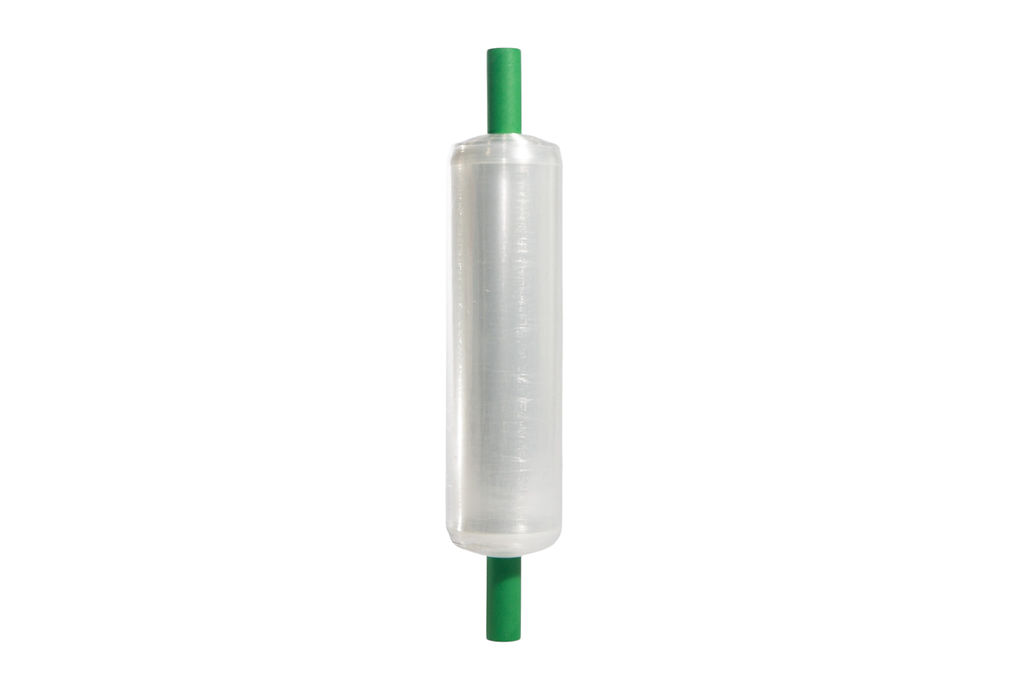
Taigan’s t.nano range also includes hand wrappers.
The hand wrappers are pre-stretched to 300% according to Taigan’s product information and incorporate folded-edge technology.
This gives customers an option for manual applications where machine wrapping is not required.
The Importance of Operator Training
A film’s performance can be affected by how it is applied.
This is especially noticeable in manual wrapping environments.
Different operators may use different techniques.
One may wrap the pallet tightly while another may apply more film than necessary.
Training helps create consistency.
Operators can learn how to approach different load types and understand how the film should be applied.
This can support both load stability and material efficiency.
Multi-Layer Stretch Film and Material Efficiency
One of the reasons businesses investigate advanced stretch film technology is the possibility of improving material efficiency.
However, material reduction should never be considered separately from packaging performance.
Using less film is only useful if the pallet remains adequately contained.
The objective is to achieve the required result with an appropriate amount of material.
This is where testing becomes important.
What Is Yield Testing in Multi-Layer Stretch Film?
Yield testing measures how much film is being used during the wrapping process.
Instead of relying on estimates, a business can determine the actual amount of film applied to a pallet.
The results can then be assessed alongside load stability.
For example, a business may discover that similar pallets are being wrapped with significantly different amounts of film.
This can indicate an opportunity to review the process.
Why Yield Testing Matters for Multi-Layer Stretch Film
Small differences in film consumption can become significant when multiplied across a large operation.
If a warehouse wraps hundreds or thousands of pallets each month, unnecessary film usage can add up.
Yield testing can help identify where this is happening.
It can also provide a baseline against which future packaging improvements can be measured.
More Multi-Layer Stretch Film Does Not Necessarily Mean a Better Pallet
One common assumption is that a pallet becomes stronger when more stretch film is applied.
This is not necessarily true.
The objective is not to cover the pallet with as much material as possible.
Instead, the wrapping process should provide the required containment for the particular load.
Excessive film may increase costs without providing a meaningful improvement in performance.
Choosing Multi-Layer Stretch Film for Your Application

Before selecting Multi-Layer Stretch Film, businesses should understand their packaging requirements.
Start by considering the load itself.
Product Weight
Heavy products can place greater demands on the wrapping system.
Load Shape
Irregular loads may require different containment characteristics.
Product Edges
Sharp or exposed edges can increase the risk of film damage.
Pallet Dimensions
The height and width of the load influence the wrapping process.
Transport Conditions
Long-distance transportation may require greater attention to load stability.
Wrapping Equipment
Machine and hand wrapping applications may require different film characteristics.
Packaging Problems Can Have Different Causes
When a business experiences pallet wrapping problems, changing the film is not always the answer.
For example, film breaking could be related to:
- Excessive tension
- Sharp product edges
- Incorrect machine settings
- Poor wrapping technique
- An unsuitable film
Likewise, unstable loads may be caused by the way products are stacked rather than the film itself.
This is why understanding the complete packaging process is important.
Packaging Assessments Can Identify Opportunities
A packaging assessment allows the wrapping process to be examined from beginning to end.
This can include:
- Reviewing the pallet
- Examining the product
- Measuring film consumption
- Reviewing wrapping technique
- Assessing load stability
- Testing alternative film
- Reviewing equipment settings
The results can help businesses make decisions based on actual performance.
Multi-Layer Stretch Film and Sustainability
Packaging sustainability is increasingly part of business decision-making.
For many companies, the goal is not simply to use more sustainable materials.
It is also to avoid unnecessary material consumption.
Efficient Multi-Layer Stretch Film application can therefore form part of a broader packaging strategy.
Taigan M-Stretch has developed initiatives around material reuse and recycling as part of its approach to packaging.
Taigan’s Core Swop Programme

Taigan M-Stretch operates a core swop programme designed to encourage the reuse of green film cores.
Customers can use flow bins to collect used cores.
Taigan can then retrieve and reuse them.
This initiative can help customers keep production floors more organised while reducing unnecessary waste from used cores.
It demonstrates that packaging efficiency can extend beyond the film itself.
Recyclable Stretch Film
Taigan’s stretch film products are recyclable according to the company’s product information.
The t.nano range also contains 30% post-recyclable content.
These characteristics form part of Taigan’s approach to improving material responsibility while continuing to focus on packaging performance.
Businesses considering sustainability should look at the complete lifecycle of their packaging materials and how efficiently they are being used.
Multi-Layer Film Does Not Mean One Solution Fits Everyone
It can be tempting to think that a more advanced film automatically solves every pallet wrapping problem.
It does not.
Every application is different.
A packaging solution that performs well for one business may not be appropriate for another.
This is why Taigan focuses on understanding the customer’s application before recommending a solution.
The Importance of Technical Support
Packaging technology can be difficult to evaluate without practical experience.
Businesses may know that their current packaging costs are high without knowing exactly why.
Technical support can help identify the cause.
This may involve:
- Product recommendations
- Yield testing
- Packaging assessments
- Operator training
- Machine guidance
- Wrapping optimisation
The objective is to improve the complete packaging process rather than simply replace one product with another.
Optimising Your Wrapping Process
A useful packaging review can start with five simple questions:
1. How much film are we using per pallet?
Measure actual usage.
2. Are our pallets stable?
Check the finished loads during handling.
3. Are operators wrapping consistently?
Look for differences between shifts and individuals.
4. Are machine settings appropriate?
Review the equipment and film combination.
5. Are we using the right film for our loads?
Consider whether the film construction matches the application.
The answers can highlight opportunities for improvement.
Multi-Layer Stretch Film for High-Volume Operations
High-volume operations often have the greatest opportunity to benefit from packaging optimisation.
A small reduction in unnecessary film usage can become significant when repeated across thousands of pallets.
Similarly, improving wrapping consistency can reduce variation across shifts and production areas.
This is why stretch film should be viewed as part of the overall operational process.
The t.nano Approach
Taigan M-Stretch developed its t.nano range around advanced cast extrusion technology.
The 33-layer, 55-layer and 67-layer products provide different options for businesses with different wrapping requirements.
The range includes both machine and hand wrapping solutions.
Combined with technical support and training, this allows Taigan to approach stretch film as a complete packaging solution rather than simply a commodity product.
Taigan M-Stretch’s Triangle of Trust
Taigan M-Stretch was established in 2005 around three founding principles:
Quality. Service. Reliability.
These principles form what Taigan calls its Triangle of Trust.
The philosophy is based on providing customers with consistent products while building long-term relationships and supporting their packaging requirements.
For businesses purchasing packaging materials regularly, reliable supply and ongoing support can be just as important as the product itself.
Supporting Customers Across South Africa
Taigan M-Stretch has a national footprint with distribution centres in:
- Johannesburg
- Cape Town
- Mbombela
- Gqeberha
This allows the company to support customers in different regions while maintaining its focus on service and technical assistance.
Frequently Asked Questions
What is multi-layer stretch film?
Multi-layer stretch film is manufactured using multiple layers within the film structure. These layers can be engineered to provide a combination of characteristics such as strength, stretchability and load retention.
Is multi-layer stretch film stronger?
Multi-layer construction can be engineered to improve particular performance characteristics but strength depends on the overall film construction and application.
What is t.nano?
t.nano is Taigan M-Stretch’s range of multi-layer cast stretch film products.
How many layers does t.nano have?
The t.nano range includes 33-layer, 55-layer and 67-layer cast stretch film.
Can multi-layer stretch film be used on machines?
Yes. Taigan’s t.nano machine rolls are designed for semi-automatic and automated wrapping lines.
Can multi-layer stretch film be recycled?
Taigan states that its stretch film is recyclable. Specific recycling processes can depend on local collection and recycling facilities.
How can I reduce stretch film usage?
Start by measuring film consumption per pallet and assessing load stability. Yield testing and wrapping optimisation can help identify unnecessary film usage.
Conclusion
Multi-layer stretch film represents an important development in modern pallet packaging.
By using multiple layers within the film structure, manufacturers can engineer stretch film with a combination of performance characteristics designed for demanding applications.
Taigan M-Stretch’s t.nano range brings this technology to pallet wrapping through its 33-layer, 55-layer and 67-layer cast stretch film products. The range includes options for both hand wrapping and semi-automatic or automated machine applications.
But choosing the right film is only the beginning.
The strongest packaging strategy considers the film, the load, the wrapping equipment and the application process together. Yield testing, operator training and packaging assessments can help businesses understand how their current process is performing and where improvements may be possible.
Ultimately, the goal is not simply to use more or less stretch film.
It is to achieve the right level of load stability and protection while using packaging materials efficiently.
For businesses reviewing their pallet wrapping processes, multi-layer stretch film can be an important part of that conversation.