An automatic pallet wrapping machine can do far more than wrap a pallet at the end of a production line. When correctly selected and configured it can become an important part of a more efficient packaging operation by improving consistency, controlling film usage and helping businesses maintain reliable load stability.
For companies handling large volumes of pallets every day manual wrapping can become time-consuming and difficult to standardise. Operators may apply different amounts of film or use different wrapping techniques which can affect the quality of the finished pallet. An automated system provides a more controlled process while allowing employees to focus on other tasks within the operation.
At Taigan M-Stretch the focus is not simply on supplying packaging equipment. The goal is to look at how film technology, machinery and the way a pallet is wrapped work together. The right combination can help businesses improve productivity while reducing unnecessary material usage and packaging costs.
What is an automatic pallet wrapping machine?
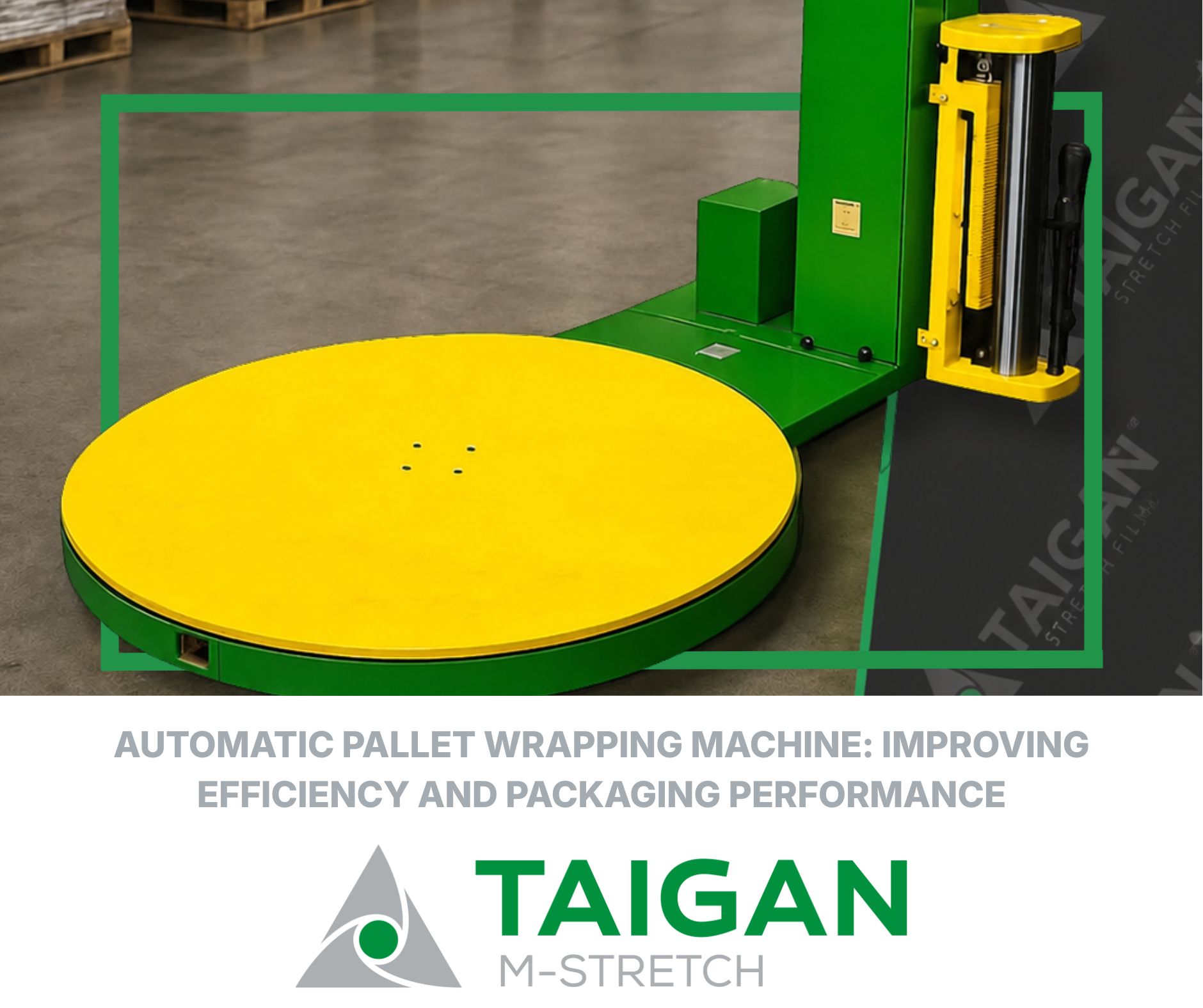
An automatic pallet wrapping machine is a packaging system designed to wrap pallets with stretch film with minimal manual intervention.
Instead of an operator walking around each pallet while applying film by hand, the machine controls the wrapping process according to its programmed settings. Depending on the equipment and application this can include controlling the number of wraps, film application and other aspects of the wrapping cycle.
Automatic systems are particularly useful where a business has a consistent flow of pallets moving through production, warehousing or distribution.
The objective is not simply to make wrapping faster. A properly configured machine can help create a repeatable wrapping process where pallets are wrapped in a more consistent way from one cycle to the next.
This consistency can be particularly important for businesses transporting products over long distances or handling loads that need dependable containment throughout storage and distribution.
Why businesses move towards automatic pallet wrapping
Manual pallet wrapping can work well for lower-volume operations. As the number of pallets increases however the process can become a bottleneck.
Employees may spend a significant amount of their working day moving around pallets and applying stretch film. The amount of film used can also vary from one operator to another.
Automation provides an opportunity to bring greater control to this part of the packaging process.
Some of the potential advantages include:
- More consistent wrapping cycles
- Improved production line efficiency
- Better control over film application
- Reduced reliance on manual wrapping
- Improved pallet stability
- Greater wrapping consistency between operators
- Potential reduction in unnecessary film consumption
- Easier integration into an end-of-line packaging process
- Better use of labour within high-volume operations
The exact benefits depend on the products being wrapped, pallet configuration, film specification and machine settings. Automation should therefore be viewed as part of a complete packaging solution rather than an isolated equipment purchase.
Consistency is one of the biggest advantages

One of the challenges with manual wrapping is that people naturally work differently.
One operator may use more film than another. One may apply more tension while another may wrap the pallet more loosely. The number of wraps can also vary depending on the operator and the perceived requirements of the load.
These differences may seem small when looking at an individual pallet. Across hundreds or thousands of pallets however they can become significant.
An automatic pallet wrapping machine provides a controlled wrapping cycle. Once the machine has been properly set up the same basic process can be repeated across the production run.
This creates greater consistency in the way pallets leave the packaging area.
Consistency also makes it easier to identify problems. If a pallet is not performing as expected the business can investigate the film specification, machine settings, load configuration or wrapping pattern instead of relying entirely on individual operator technique.
Automatic pallet wrapping machine can help control stretch film usage
Film consumption is an important part of pallet wrapping costs.
Using too little film can compromise load containment. Using more film than necessary increases material consumption without necessarily providing a meaningful improvement in pallet performance.
An automatic pallet wrapping machine can provide greater control over the application process.
The automatic pallet wrapping machine can be configured according to the requirements of the particular load. This creates an opportunity to move away from the idea that every pallet simply needs “more film” and towards a more measured approach.
The objective should be to use the appropriate amount of film to achieve the required load stability.
This is where automatic pallet wrapping machine and film technology need to be considered together.
A high-performance stretch film may allow a business to achieve the required containment using less material than a conventional film. The machine must then be configured correctly so the film’s characteristics are being used effectively.
Buying an automatic pallet wrapping machine without looking at the film and wrapping process as a whole can therefore leave potential savings on the table.
The importance of the film and automatic pallet wrapping machine combination
A wrapping machine does not operate independently from the stretch film.
The film specification, stretch characteristics, load type and machine settings all influence the final result.
For example a film designed for automated wrapping needs to perform consistently through the machine. If the film is not suited to the equipment or application it can lead to issues such as breaks, inconsistent tension or poor load containment.
Taigan’s approach combines advanced film technology with packaging equipment and technical support.
The t.nano range includes multi-layer cast stretch films designed for demanding pallet wrapping applications. The range is intended to support efficient film usage while maintaining the strength and load containment required for different applications.
This is important because automation should not simply mean wrapping pallets faster. The objective is to create a packaging process that performs reliably while using resources intelligently.
When should a business consider an automatic pallet wrapping machine?
There is no single pallet volume that means every business should automate.
The decision depends on several factors including production volume, labour requirements, available floor space, pallet types and the consistency required from the finished load.
automatic pallet wrapping machine may be worth investigating when:
Pallet volumes are increasing
As production grows the amount of time spent wrapping pallets can increase quickly.
A process that worked perfectly well when a business handled a small number of pallets may become inefficient as volumes increase.
An automated system can help packaging operations keep pace with higher throughput.
Manual wrapping is becoming a bottleneck
If pallets are waiting to be wrapped before they can move into storage or dispatch then the wrapping stage may be restricting the wider operation.
Looking at the complete workflow can reveal whether automation could improve the movement of products through the end-of-line process.
Film usage varies significantly
If different operators are using noticeably different amounts of stretch film the business may have an opportunity to improve consistency.
An automatic machine provides more control over the wrapping cycle and makes it easier to establish repeatable settings.
Employees are spending too much time wrapping
Manual pallet wrapping can be physically demanding. Repetitive movement around pallets can place strain on workers particularly where wrapping is performed throughout a shift.
Reducing unnecessary manual handling can help businesses use their employees’ time more effectively while creating a more controlled wrapping process.
Load stability is critical
Businesses transporting products through multiple stages of handling need confidence that pallets will remain stable.
Consistent wrapping can contribute to dependable load containment when the correct film and wrapping settings are used.
Automatic does not always mean fully automated
Packaging automation exists at different levels.
Some businesses may need a fully automatic wrapping solution integrated into an existing production or distribution line. Others may benefit from a semi-automatic system that reduces manual work without requiring complete end-of-line automation.
The right choice depends on the operation.
A semi-automatic wrapping machine can be useful where pallet volumes justify machine wrapping but the overall production line does not require a fully automated system.
A fully automatic system can be more appropriate where pallets move through a consistent production process and the wrapping stage needs to integrate with other equipment.
The important question is not simply whether a machine is automatic. It is whether the equipment matches the way the business operates.
What should you consider before buying a automatic pallet wrapping machine?
Choosing a machine based only on its advertised speed can result in the wrong solution.
A proper assessment should consider the complete application.
Pallet dimensions
Pallet sizes and load heights can vary. The machine needs to accommodate the dimensions being handled within the operation.
Product characteristics
A stable box pallet may require a different wrapping approach from an irregular or fragile load.
Products that move during handling can require careful consideration of film performance and wrapping settings.
Production volume
The number of pallets wrapped per hour and per shift helps determine the level of automation required.
Existing equipment
The machine may need to fit into an existing production line or work alongside conveyors and other end-of-line packaging equipment.
Film requirements
The selected film should be compatible with the machine and suitable for the application.
Available space
Floor layout is an important practical consideration. The machine needs to fit into the production or dispatch environment without creating new workflow problems.
Maintenance and technical support
A machine is only useful when it remains operational.
Installation, preventative maintenance, servicing and technical support should therefore form part of the purchasing decision.
Machine performance depends on correct settings
Installing a wrapping machine is only the beginning.
Incorrect settings can result in excessive film consumption or insufficient containment. Both can create unnecessary costs.
A machine should be configured around the actual load and film being used.
This may involve reviewing:
- Wrapping patterns
- Number of rotations
- Film tension
- Film stretch
- Load height
- Pallet configuration
- Film specification
- Application requirements
Small adjustments can sometimes have a meaningful effect on the finished pallet and the amount of film consumed across a production run.
This is one reason technical support is important when introducing automated wrapping.
The role of packaging audits
Businesses often know how much stretch film they purchase but may not know exactly how efficiently that film is being used.
A packaging audit can help bridge that gap.
The process can involve looking at the current wrapping method, measuring film consumption and assessing pallet stability. The information gathered can then be used to identify opportunities for improvement.
Rather than making assumptions about how much film a pallet “should” use the business can work with actual data from its operation.
This approach is particularly valuable when considering an automatic pallet wrapping machine because it creates a baseline against which improvements can be measured.
Data can make a automatic pallet wrapping machine more useful
Modern packaging operations are increasingly moving towards data-driven decision-making.
Wrapping equipment can form part of this approach by providing information that helps businesses understand how their packaging process is performing.
Taigan’s packaging optimisation approach includes remote monitoring, analytics, audits and machine optimisation.
The value of data is not simply having more numbers. The objective is to turn those numbers into practical decisions.
For example a business may discover that one pallet type consistently consumes more film than expected. Further investigation could reveal that the load configuration or wrapping settings need adjustment.
Another application may show that the automatic pallet wrapping machine is operating consistently but the film specification could be optimised.
This creates a more informed approach to packaging management.
Automatic pallet wrapping machine can support workplace efficiency
The benefits of automatic pallet wrapping machine are not limited to material and production costs.
Manual wrapping can involve repetitive physical movement throughout the working day. Reducing the amount of manual wrapping required can help employees spend more time on other activities within the operation.
Taigan also offers solutions such as the Bolt Applicator used with Taigan Rocket. The fatigue-fighter system is designed to reduce physical strain during packaging activities.
This highlights an important point about packaging automation: the best solution should consider both the efficiency of the process and the people operating within it.
Automatic pallet wrapping machine and sustainability
Using less material where performance allows can be an important part of improving packaging efficiency.
Taigan’s “Less Plastic is Best” philosophy focuses on reducing unnecessary film consumption while maintaining the performance needed to protect and stabilise loads.
An automatic pallet wrapping machine can support this approach by providing greater control over film application.
The automatic pallet wrapping machine itself does not automatically make a packaging operation more sustainable. The outcome depends on how the system is configured and managed.
Using excessive film on an automated machine is still excessive film use.
The stronger approach is to combine efficient equipment with appropriate film technology, accurate settings, regular assessment and ongoing optimisation.
This can help businesses pursue measurable improvements rather than relying on broad sustainability claims.
What happens after installation?
A successful machine installation should not be treated as the end of the project.
Operators need to understand how the equipment works. Settings may need to be adjusted as products or production requirements change. Preventative maintenance is also important for keeping equipment operating reliably.
Taigan’s Machine Division provides installation, training, preventative maintenance, servicing and ongoing technical support.
This creates a longer-term relationship around the packaging process rather than treating the machine as a once-off purchase.
Ongoing support can also help identify opportunities to improve performance as the operation develops.
Buy, rent or loan: choosing the right approach
The upfront cost of packaging equipment can sometimes make businesses hesitant to automate.
For this reason Taigan provides selected wrapping machines through different commercial options including buy, rent or loan arrangements. Selected machines may also be made available on a consignment basis depending on the application.
This gives businesses an opportunity to consider automation without automatically assuming that purchasing equipment outright is the only route.
The right option will depend on the business’s production volume, cash flow requirements and long-term packaging strategy.
A proper assessment should consider the total cost of the wrapping process rather than looking only at the initial machine price.
Automatic pallet wrapping machine should be measured by results
A automatic pallet wrapping machine can be impressive on paper and still fail to deliver the expected benefits if it is not suited to the application.
The better question is:
What should the wrapping process achieve?
For one business the priority may be increased throughput.
For another it may be reducing film consumption.
Another operation may be focused on improving pallet stability or reducing the amount of manual labour required.
In many cases the objective will be a combination of these factors.
This is why a packaging solution should start with the operation rather than with a machine catalogue.
A smarter approach to pallet wrapping
An automatic pallet wrapping machine can provide a significant improvement to a packaging operation when it is properly selected, installed and optimised.
The biggest opportunity does not necessarily come from automatic pallet wrapping machine alone. It comes from bringing the right equipment together with the right stretch film, correct machine settings, operator training and ongoing performance monitoring.
For businesses handling high volumes of pallets this approach can help create a more consistent process while supporting better productivity and more controlled film usage.
At Taigan M-Stretch the focus is on looking at the complete packaging operation. From advanced stretch film technology and wrapping equipment to audits, training and technical support, the aim is to help businesses wrap smarter and waste less.
Looking for an automatic pallet wrapping machine?
If your business is considering an automatic pallet wrapping machine, start by looking at the process you already have.
Understanding your current film consumption, pallet volumes, load stability and wrapping workflow can help identify where automation could make the biggest difference.
Taigan’s Machine Division provides semi-automatic and fully automatic wrapping solutions together with installation, servicing, maintenance and technical support.
The right machine should not simply wrap pallets. It should form part of a packaging system designed around performance, consistency and efficiency.
For businesses ready to improve the way they wrap, a properly assessed automatic pallet wrapping machine solution can be the next step towards a smarter packaging operation.